Edge Protection Q&A
Why is edge protection necessary for mezzanines?
The purpose of a mezzanine is to maximize the cubic space of a facility. From a risk perspective, mezzanine safety becomes a critical concern because employees are performing tasks at elevation. While a fixed mezzanine guardrail is often installed around the perimeter, openings are required to load and unload palletized material. These transitions directly impact material handling safety, particularly where lift trucks interface with elevated work areas.
These openings are especially problematic because employees work at these ledges to remove pallets or to pick products. Without a properly designed pallet gate, workers are exposed to unnecessary fall hazards. When employees are working they often performing repetitive motions that involve lifting and twisting. Unguarded edges introduce serious fall protection concerns. Installing mezzanine gates for safety will help to ensure protection remains constant and reliable.
With a permanent mezzanine barrier in place, the edge stays protected. A well-engineered fall protection safety gate helps to mitigate employee safety hazards.
What types of protection are available? How effective are they?
There are many solutions for protected mezzanine ledges, but not all meet OSHA barrier requirements or current mezzanine regulations. Historically, these areas have been guarded with chains or removable devices. Latch chains were widely used but often failed to meet strength standards. In many facilities, chains created more protection concerns than solutions due to misuse and trip hazards.
The industry later adopted removable barriers and swing systems. While these devices functioned as platform safety gates, they still depended on workers to reposition them correctly after each use. Because human behavior is unpredictable, barriers were frequently left open. This is why the concept of a controlled access zone became central to modern safety design.
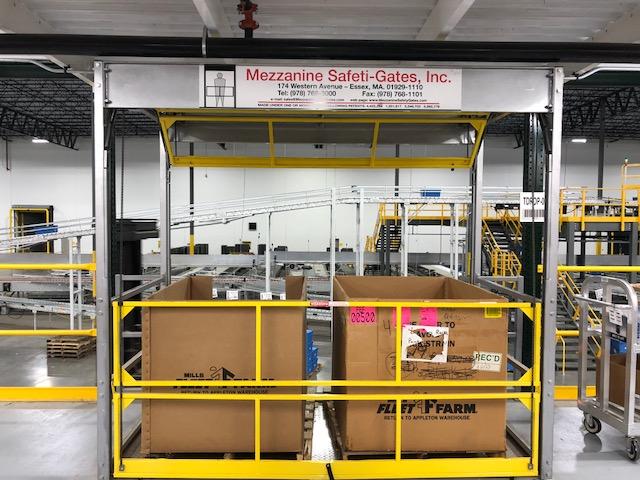
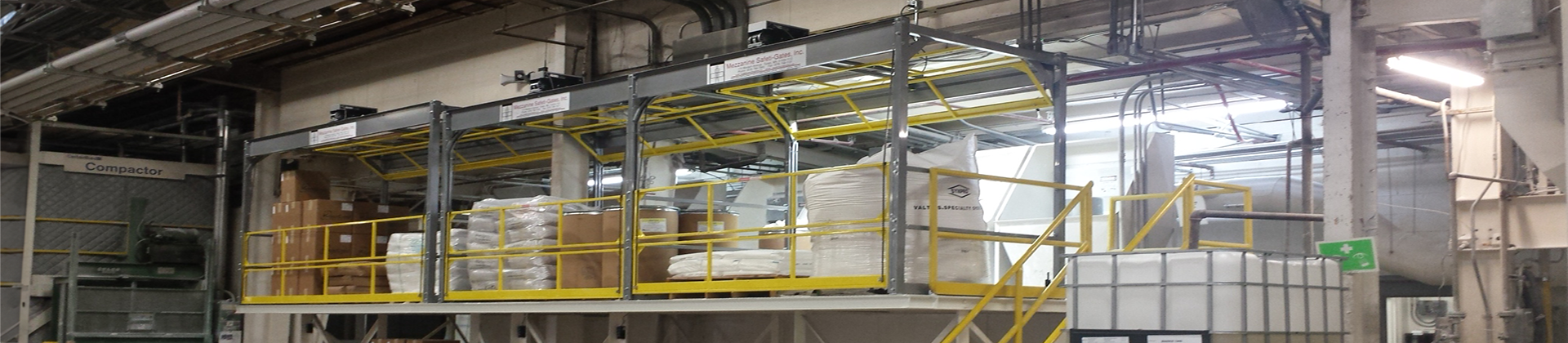
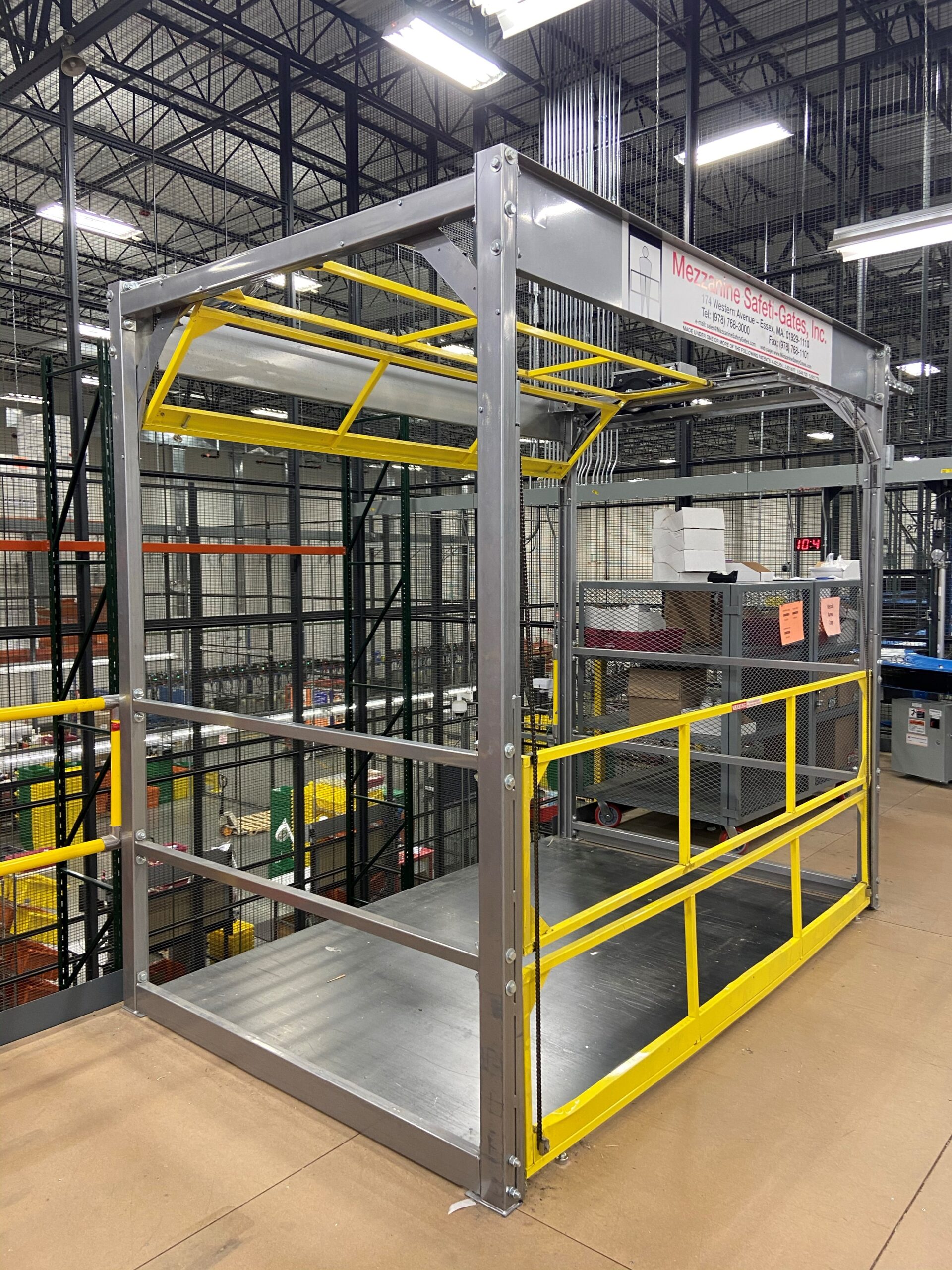
Self-closing swing gates improved performance but introduced new limitations. A staged pallet can unintentionally leave the edge unprotected. ANSI standards now emphasize that maintaining separation at all times is crucial for safety. Dual-gate designs function as true platform safety gates, ensuring one side remains closed during material transfer. This type of system is commonly recognized as one of the best warehouse safety gates because it removes reliance on memory or procedure.
Mezzanine Safeti-Gates, Inc. introduced first dual-gate system on the market, the original Roly® Safety-Gate, and established the benchmark for OSHA safety gates used across North America.
How do MH facilities select appropriate edge protection solutions?
Most often, facility safety managers evaluate options based on workflow, layout, and OSHA mezzanine requirements. Every application presents unique operational constraints. Selecting the correct platform safety gate depends on available space, pallet sizes, and traffic patterns. Environmental conditions may also influence material choice.
Facilities frequently consult Mezzanine Safeti-Gates, Inc as the leading safety gate distributor for North America. We help ensure compatibility with system design and compliance standards. Working with an OSHA-compliant safety gate manufacturer allows safety teams to align their safety gate needs with OSHA regulations and operational efficiency.
How can MH facilities do a better job of identifying and protecting edges?
Effective hazard reduction begins with open communication. Employees interacting with gate racks, pallet drops, and elevated work zones often identify risks first. This is an opportunity for management to assess workflows tied to loading bay edge protection, transfer points, and worker movement. Many incidents originate at these interfaces.
Consulting a specialist can help determine where a fall protection gate or loading dock barrier gate is needed. And proper placement is just as important as product selection. Dedicated loading dock safety barriers are especially important in areas with vehicle movement or shifting loads. Implementing an engineered loading dock lift gate solution can further reduce exposure at dock transitions.
Mezzanine Safeti-Gates, Inc. is proud to offer a variety of mezzanine safety gates custom-designed for your unique work area.
Why is it important to raise awareness of edge protection within the industry?
Falls remain one of the most serious workplace hazards. Expanding automation combined with taller storage systems intensifies loading dock fall protection challenges. A single fall-related incident can disrupt operations and trigger costly investigations. Facilities that use loading dock safety gates significantly reduce this risk.
Financial consequences continue to rise as enforcement evolves. Compliance with OSHA safety gate standards is no longer optional. It has become operationally essential. Beyond cost, worker safety directly affects morale and organizational stability. Properly installed safty gates play a vital role in maintaining safe work spaces.
What do we expect the upgraded ANSI standards to include?
Mezzanine Safeti-Gates, Inc. predicts that the intent will remain focused on injury prevention. Updated guidance will likely refine expectations surrounding OSHA safety gate requirements and elevated platform design. Clarifications may further define acceptable uses for pivoting gate systems and pivot gate configurations across diverse applications.
Is there anything else you should know?
Elevated mezzanines are only part of the safety landscape. Multi-level pick modules present similar risks requiring OSHA-compliant mezzanines and properly integrated pallet gates. Rack-supported systems frequently contain pallet drop locations where platform safety gates are necessary. These work environments often involve repetitive motion and high traffic density.
Return lanes, pallet flow systems, and staging areas also demand attention. Installing a stainless steel pallet gate may be appropriate in washdown or corrosive environments. We also see growing demand for specialized pivot gate designs where space constraints prevent traditional configurations. A properly engineered pivoting gate preserves clearance while providing protection. Certain facilities integrate TCA controls for automated safety sequencing. These systems ensure gates respond predictably within high-speed material handling operations.
Ultimately, consistent edge protection is not a luxury. In today’s material handling environments, it’s a requirement. A properly designed OSHA safety gate system ensures safety remains active regardless of workflow conditions.
Contact Mezzanine Safeti-Gates today to discuss your safety gate needs. We offer custom jobs for varying environments.