Fall Protection and Safety Gate FAQs

FALL PROTECTION AND SAFETY GATE FAQS

Effective fall protection is a critical component of warehouse and industrial safety. Mezzanine Safeti-Gates, Inc. designs mezzanine safety gates and related systems to help facilities protect workers at elevated pallet drop areas, mezzanines, and loading zones. If you have a question about pallet drop systems or loading dock safety gates not listed below, give us a call at 978-768-3000.


How do mezzanine safety gates work?

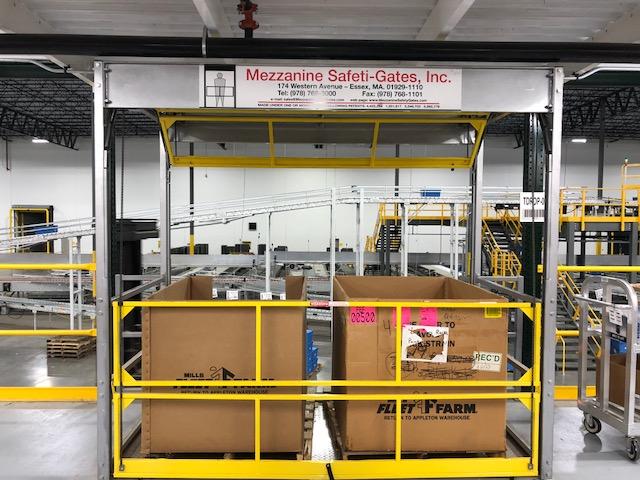
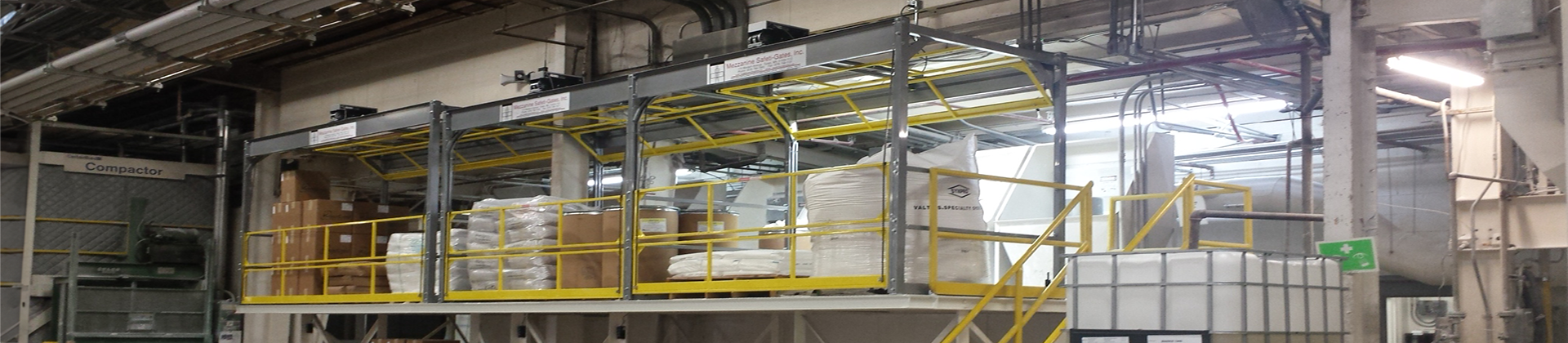
Safety gates from Mezzanine Safeti-Gates use a dual-gate system that is designed to provide continuous fall protection. The interconnected steel gate design uses counterbalanced gates to create a controlled-access area. When the ledge gate is lifted, the rear gate lowers to secure the elevated edge while materials are loaded. When the ledge gate is lowered, the rear gate raises, allowing access while preventing exposure to an open drop area.


Total Control Access (TCA) safety gates use power operation and proprietary technology that provide for the ledge and rear gate to operate separately. One gate must be completely closed before the other gate can begin to open.

At what height do I need fall protection in my facility?

OSHA's Walking-Working Surfaces Standard 1910.28 requires proactive measures on any exposed ledge of an elevated working surface of four feet or higher. ANSI standards require the barrier at three feet or higher. 

Are mezzanine safety gates required by OSHA?


Yes. OSHA standard 29 CFR 1910.23 (Walking-Working Surfaces) requires that all open-sided floors, mezzanines, and elevated platforms with a drop of four feet or more be protected by a guardrail system, safety gate, or equivalent fall protection. A passive, self-closing safety gate — such as the Roly® or RobotGate® — is the OSHA-preferred solution because it eliminates the open gap that swing gates and chains create during pallet loading and unloading operations. Without compliant gate protection, facilities are subject to OSHA citations and significant financial penalties.
 

What OSHA standard applies to mezzanine pallet drop gates?

The primary standard is OSHA 29 CFR 1910.23, which covers guarding of floor and wall openings and holes, including mezzanine edges. For construction environments, 29 CFR 1926.502 governs fall protection systems. Both standards require that openings used for material handling be protected at all times — including during active loading — which is why a self-closing, passive gate design is the compliant choice. Mezzanine Safeti-Gates designs every product to meet or exceed these requirements, and each gate maintains a compliant barrier throughout the loading cycle without requiring the worker to manually open or close a gate.

Can a swing gate or safety chain satisfy OSHA fall protection requirements on a mezzanine?

Technically a swing gate or safety chain can satisfy the letter of OSHA requirements — but only when closed. The compliance problem is the gap that occurs when the gate is open or the chain is unhooked during an active pallet transfer. OSHA's general duty clause requires that hazards be controlled, and an open fall hazard during a routine operation does not meet that standard. A passive, self-closing safety gate like the Roly® maintains a continuous protective barrier — one side always closes as the other opens — so the mezzanine edge is never exposed. This is why EHS professionals and OSHA compliance officers consistently recommend passive gate systems over swing gates or chains in mezzanine applications.

Are there other fall protection requirements besides OSHA?

Yes, ANSI MH32.1-2018, Stairs, Ladders and Open-Edge Guards for Use with Material Handling Structures outlies requirements for material handling structures, including pallet drop openings, even while the area is in use for handling materials. Dual-gate pallet drop safety gate systems meet ANSI standards because a barrier is in place even during the active loading and unloading of material. Single barrier systems such as swing, sliding or lift out gates do not meet the standard.


International Building Code (IBC) Section 1015 Means of Egress, Guards governs means of egress on elevated walking surfaces. Additional requirements appear in Chapter 5.

Canadian facilities must comply with Canadian Centre for Occupational Health and Safety (CCOHS) requires fall protection at heights over three meters.


What is the load rating for a Mezzanine Safeti-Gates product?

Load ratings vary by model and are specified at the time of order based on the customer's application. Our standard gate configurations are engineered to meet OSHA guardrail force requirements — a minimum of 200 lbs of top rail force in any direction, as required by 29 CFR 1910.23. For applications involving heavy pallet loads, high-cycle forklift operations, or robotics cell perimeter guarding, we engineer gates to the specific dynamic and static load requirements of the installation. Load capacity, gate opening width, and structural mounting requirements are confirmed during the quoting process to ensure the right gate is specified for every application.

What gate opening widths are available?

Mezzanine Safeti-Gates manufactures safety gates in a wide range of opening widths to accommodate everything from hand-pallet jacks to full-size forklift loads. Standard configurations cover openings from 48 inches to 120 inches, and custom widths outside that range are available. The correct width is determined by the load dimensions, the equipment being used (pallet jack, reach truck, forklift), and the structural bay dimensions of the mezzanine. Our sales team works through these specifications during the quoting process to ensure the gate fits the application precisely.

Are Mezzanine Safeti-Gates products made in the USA?

Yes. All Mezzanine Safeti-Gates products, including the Roly® and RobotGate® product lines, are manufactured in the United States. Domestic manufacturing means tighter quality control, shorter lead times for most orders, and no exposure to overseas shipping delays. It also supports customers who require domestic-sourced products for government contracts or corporate procurement policies.

How difficult is it to install a Mezzanine Safeti-Gates product?


Installation is designed to be completed by a facility maintenance team without specialized equipment. Gates ship with detailed installation instructions, and the mounting hardware and configuration are specified during the order process so that all anchor points align with the customer's existing mezzanine structure. Most standard installations can be completed in a matter of hours. For larger or more complex applications — such as multi-gate configurations or robotics cell perimeter installations — Mezzanine Safeti-Gates can provide additional technical guidance. No welding is required for standard installations.
 

Do Mezzanine Safeti-Gates products require ongoing maintenance?

Mezzanine Safeti-Gates products are engineered for durability in industrial environments and require minimal routine maintenance. The self-closing mechanism on the Roly® gate is a passive counterbalance system with no springs, hydraulics, or electronics to service or replace. Recommended periodic maintenance includes inspection of mounting hardware for tightness, visual inspection of structural welds and gate components, and lubrication of pivot points as needed. Gates operating in high-cycle, high-impact environments — such as busy distribution centers — should be inspected more frequently as part of a standard facility safety inspection program.

What is the typical lead time for a Mezzanine Safeti-Gates order?

Lead times vary based on product model, configuration, and current production schedule. Because every gate is customized to the customer's specific opening dimensions and mounting requirements, lead times are confirmed at the time of order. Contact our sales team for a current lead time estimate on your specific configuration — we work to balance production efficiency with the scheduling needs of facilities operating under compliance deadlines or facility expansion timelines.

Can Mezzanine Safeti-Gates build a gate to a non-standard size?

Yes. Custom sizing is a standard part of the Mezzanine Safeti-Gates ordering process, not an exception. Because mezzanine bays, pallet dimensions, and structural configurations vary widely across facilities, we engineer each gate to the customer's exact opening width and height requirements. The quoting process captures the necessary field measurements and application details to ensure every gate is built to fit precisely — no field modification or on-site fabrication required.

What information do I need to request a quote for a mezzanine safety gate?

To generate an accurate quote, we typically need: (1) the clear opening width of the mezzanine bay where the gate will be installed, (2) the gate height required (usually matching the mezzanine guardrail height), (3) the type of equipment passing through (hand pallet jack, electric pallet truck, reach truck, forklift), (4) the load weight and pallet dimensions, (5) the mezzanine deck material and structure type (to confirm mounting method), and (6) the quantity of gate openings. Our quote request form walks through each of these fields, and our sales team follows up to confirm specifications before a quote is issued.

Are Mezzanine Safeti-Gates products available in different finishes or colors?

Our standard product finish is a durable industrial powder coat in safety yellow, which meets ANSI Z535 color standards for safety equipment and maximizes visibility in warehouse and industrial environments. Alternative colors or finishes may be available depending on the model and order volume — contact our sales team to discuss specific requirements for your facility or corporate color standards.

What is the Roly® gate and when is it the right choice?

The Roly® is Mezzanine Safeti-Gates' passive, self-closing safety gate designed for mezzanine pallet drop applications. It uses a counterbalance system that keeps one side of the gate closed at all times — when the load pushes one panel down on the mezzanine side, the opposite panel rises on the floor side, and vice versa. This eliminates the exposed fall hazard that occurs with swing gates during pallet transfers. The Roly® is the right choice for any mezzanine opening where palletized loads are transferred by pallet jack, reach truck, or forklift, and where continuous OSHA-compliant fall protection is required throughout the transfer operation.

What is the RobotGate® and what applications is it designed for?

The RobotGate® is a safety gate system engineered specifically for robotic cell perimeter guarding applications. It provides a compliant, interlocked barrier around automated equipment — including robotic arms, AGVs, and collaborative robot installations — that prevents personnel from entering an active robotic work cell. The RobotGate® integrates with the cell's safety PLC or safety relay system to ensure the robot is in a safe state before the gate can be opened, and that the robot cannot resume operation while the gate is open. It is the right choice for any facility integrating industrial robotics that requires OSHA and ISO 10218-compliant personnel guarding.

How do I decide between a Roly® gate and a swing gate for my mezzanine?

The decision comes down to compliance risk and operational efficiency. A swing gate requires a worker to manually open and close it on every pallet transfer — creating a compliance gap every time the gate is open, increasing the risk of the gate being left open, and adding time to every transfer cycle. The Roly® eliminates all three problems: it closes passively without worker action, it is never fully open at the edge during a transfer, and it does not add time to the operation. For any facility that has experienced OSHA scrutiny, is operating under a compliance improvement plan, or simply wants the most defensible fall protection solution, the Roly® is the correct specification. Swing gates are generally only appropriate for very low-cycle, non-critical applications where cost is the overriding constraint and compliance risk has been formally assessed.

Can industrial safety gates be power operated?

Yes, many industrial safety gates can be dquipped with commercial motors, sensors and power stations for remote operation. Pneumatic power options are also available, specifically for our Pivot and Open Top models, which provides flexibility for high-cycle or automated environments.

Can safety gates connect to rack systems?

Yes. Our safety gates can be designed as rack-supported pallet drop gates to integrate directly with rack systems by any manufacturer. The Roly®, Pivot, Tri-Side and TCA models can be configured for rack supported applications.

What kind of fall protection is best for pick modules?

Rack supported safety gate designs are ideal for pick modules because they open and close flush with rack uprights. This approach supports pallet flow safety gate applications without extending into aisles or interfering with material handling equipment.

Are mezzanine safety gates easy to operate?

Yes, we engineer our mezzanine safety gate systems for ergonomic operation and consistent use. The dual-gate system requires no manual lifting and can be equipped with power operation for virtually no touch operation.

Are kick plate standard on mezzanine safety gates?

Our line of mezzanine safety gates include solid, four-inch kick plates on the sides of the unit and on the ledge and rear gates. The kick plates help prevent materials from sliding off elevated platforms.

Can mezzanine safety gates be equipped to communicate with AGVs and automated warehouse technology?

Yes. Mezzanine safety gates can be integrated with radio frequency, sensors and other technologies to communicate with AGVs, lift trucks and other automated material handling equipment. 

Mezzanine Safeti-Gates, Inc. designs solutions that go beyond basic compliance. From loading bay edge protection to loading dock safety barriers, our systems are engineered to protect people, pallets, and processes. Whether you need loading dock protective barriers, OSHA-compliant safety gates, or alternatives such as a pallet cargo net, our team can help you identify the right solution for your facility.

Have additional questions?

Call 978-768-3000 to speak with a fall protection specialist.
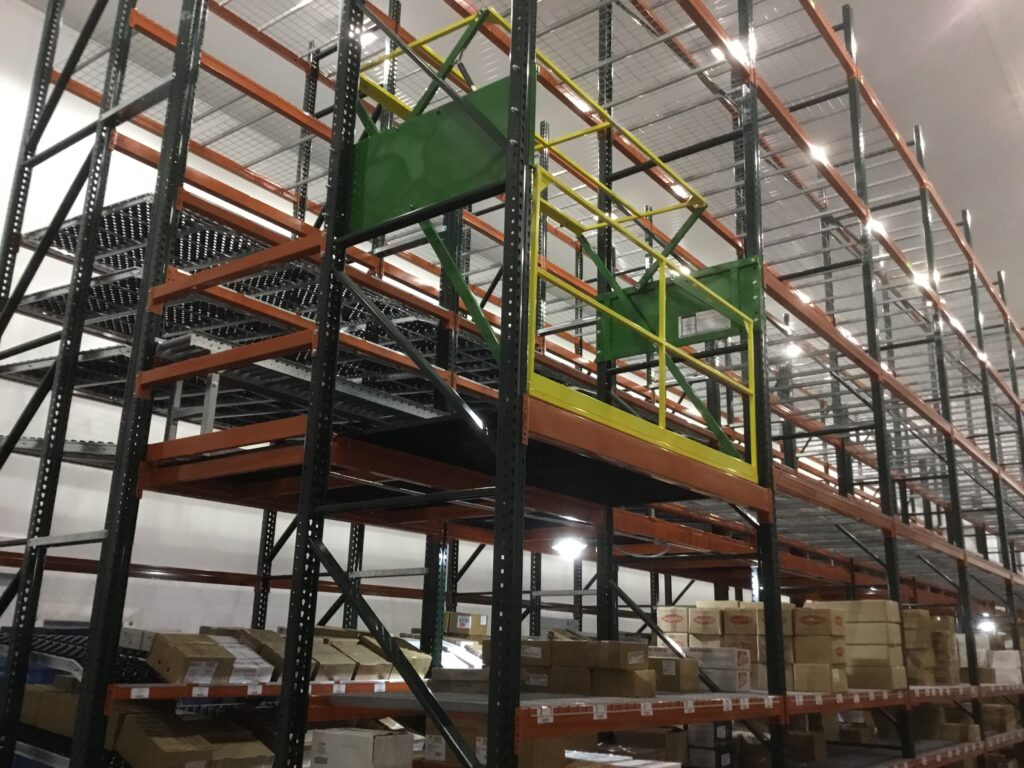
 
Rack Supported Pivoting safety gate